Imagine manually copying tracking numbers from carrier PDF manifests into your e-shop every day. Dozens of shipments, checking order numbers, assigning the right carrier. Boring, repetitive work prone to errors.
What if an AI Agent did it for you?
How It Works
The whole process is built on a simple idea: if your data is accessible via API, automation becomes trivial. The Veruno platform provides a complete REST API for managing orders, products, and tracking information. And that's the key to letting AI agents work independently.
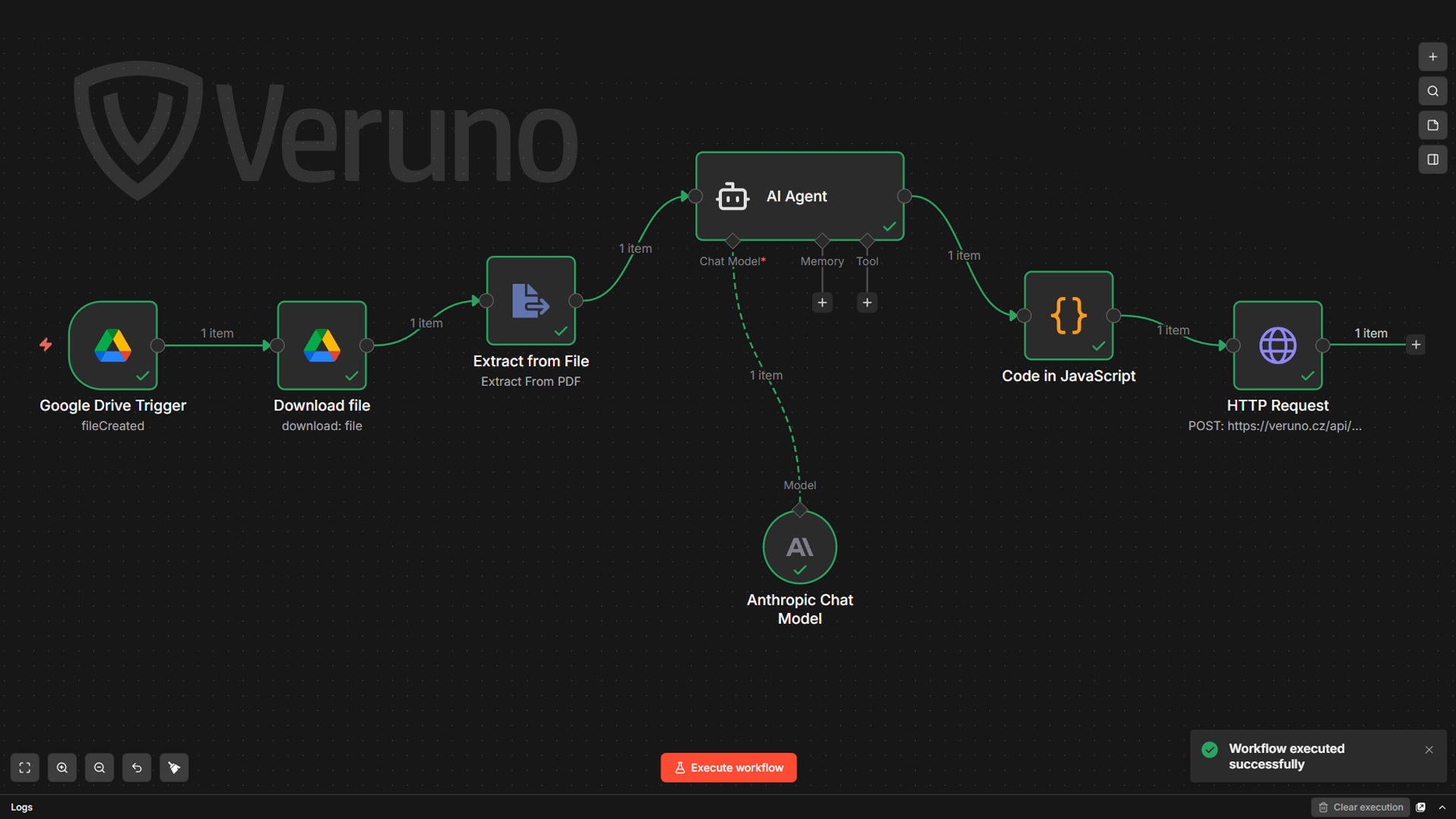
The photo shows a workflow in n8n – an open-source automation platform. The AI Agent monitors a folder on Google Drive. As soon as a new PDF file appears – a shipping manifest from DPD or GLS – it processes it automatically.

What Exactly Does the Agent Do
1. New file detection. A Google Drive Trigger watches the "Shipments" folder. Just upload a PDF and the workflow kicks off.
2. Data extraction from PDF. The agent downloads the file and extracts text from it. A DPD manifest looks different from GLS – but the agent doesn't care.
3. Intelligent parsing. This is where AI (Claude by Anthropic) comes in. The agent analyzes the text, identifies the carrier based on the document structure, and extracts tracking numbers, recipient names, destination countries, and order numbers. It handles multi-package shipments with ease – a single order split into five parcels is no problem.
4. Sending to Veruno API. The structured data is sent to POST /api/v1/{tenant}/orders/tracking and the tracking numbers are automatically assigned to orders. Done in seconds.
What's Next?
This is just the beginning of the chain. Once the agent has processed the tracking data, it can task the next agent in line:
Email agent takes care of sending notifications to customers. Country detection and email translation into the correct language is a given – a customer from Italy gets an email in Italian, a customer from Germany in German.
Monitoring agent can continuously watch shipment statuses. If it detects a problem – an undelivered package, a delay, a returned shipment – it reacts immediately. It sends a notification to the shop operator, or automatically contacts the customer with a status update.
Customer service agent answers queries: "Where is my order?" → instantly finds the tracking number and returns a link to track the shipment. In the language the customer is asking in.
Why API Is the Key
This entire automation stands or falls on one thing – access to data via API. Without it, the agent couldn't read orders, write tracking numbers, or respond to customers.
Veruno provides an open REST API for products, orders, tracking, certificates, and provenance. Complete documentation is available. This means any AI agent – whether running in n8n, LangChain, or a custom solution – can freely work with the data.
E-commerce is no longer about manual clicking in the admin panel. It's about giving AI agents the right tools and letting them do the work.
Veruno is an agentic commerce platform – infrastructure for AI agents in e-commerce. If you're interested in connecting your data with AI agents, check out veruno.cz/docs.